Saint Peter’s Church, Saligny le Vif
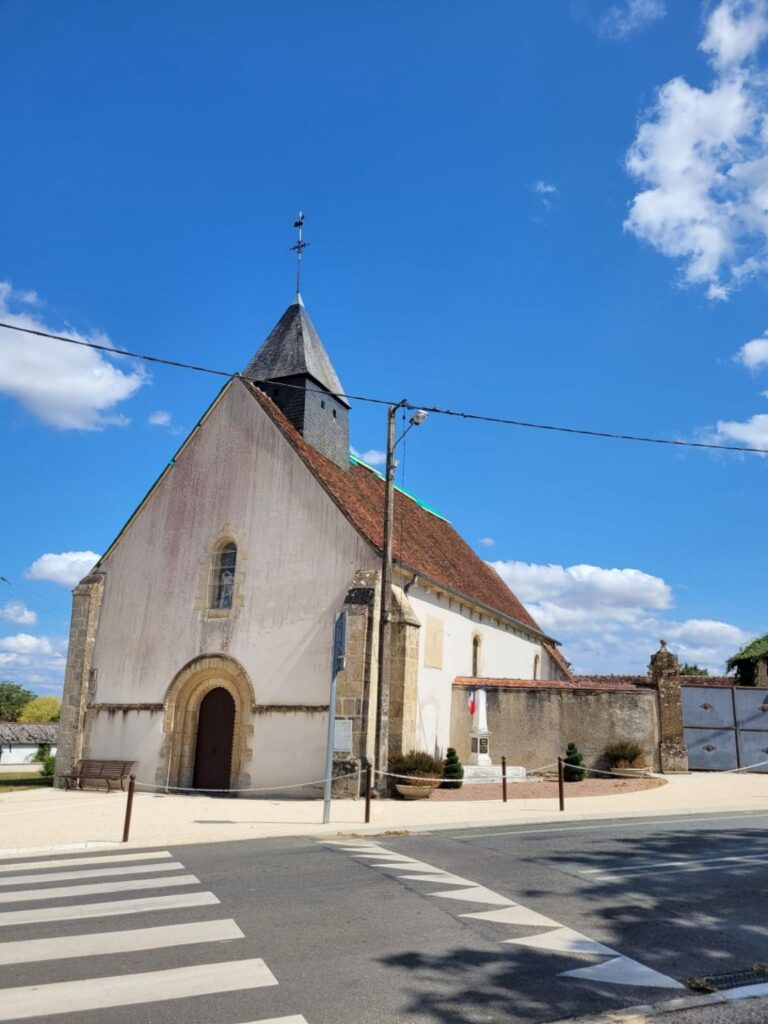
Saint Peter’s church in Saligny le Vif, Baugy, was built in the 12th century in the Romanesque style. Very simple and harmonious, it consists of a rectangular nave and choir with a vaulted wooden roof.
Small openings in the nave and the choir and the west door date back to this time.
In the 15th or 16th century, new openings were created in the nave, probably to let in more light. The arch between the nave and the choir was also modified at this time.
A chapel was built on the north side of the choir; we can note the door to the chapel, now walled up, and the buttress. The chapel was present on the cadastral plans of 1826, but then disappeared. We do not know the date of its construction.
In 1887/88 the church underwent transformations based on plans by the architect Emie Tarlier. A high opening was created in the west wall, a gallery was built, the old south side door was walled up, and a new panelled vault in the nave and the choir was created.
At the end of the 19th century or the beginning of the 20th, a vestry was built behind the choir. A door was added and part of the stained glass window (the only one remaining) was shut off.
The door
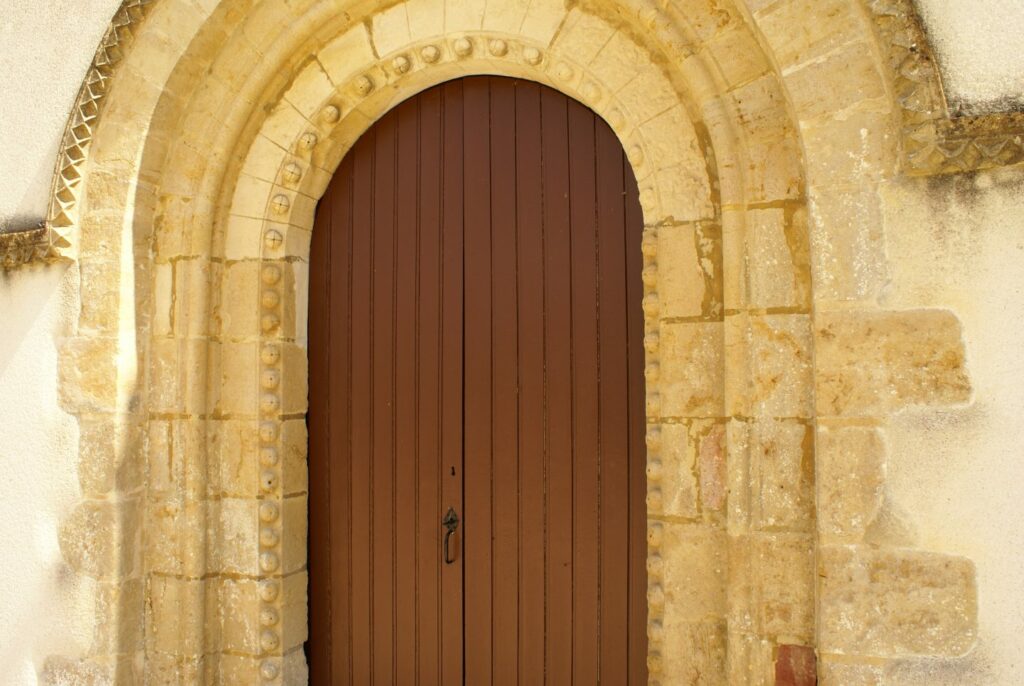
The door, which has no tympanum, is surrounded by 3 delicately ornate curved arches. The first bears a row of large pearls, each split in the shape of a cross. The second is a torus, that is a cylindrical shape. The third arch, which does not go down to the ground, bears a row of stars.
You enter Saligny church by a narthex.
The narthex is the transition between the outside and the inside, between secular and sacred, an intermediate space before entering the nave. The wall separating it from the nave has three arched openings; two small ones on the sides and a large one leading directly onto the aisle of the nave. The narthex ceiling forms the floor of the gallery above.
The gallery opens onto the interior of the church, and is large enough to walk on.
On the right of the narthex is the confessional. This liturgical furniture, made of wood, is composed of a central compartment with a door for the priest, and two other compartments, with a kneeler and a shelf, for the penitents. The confessional is normally closed by a curtain.
Next to the confessional are the stairs leading to the gallery.
The baptismal font is on the left as you go into the church. Baptism symbolizes coming out of the dank shade into the warm light. Typically, in the Catholic church, baptism is by sprinkling.
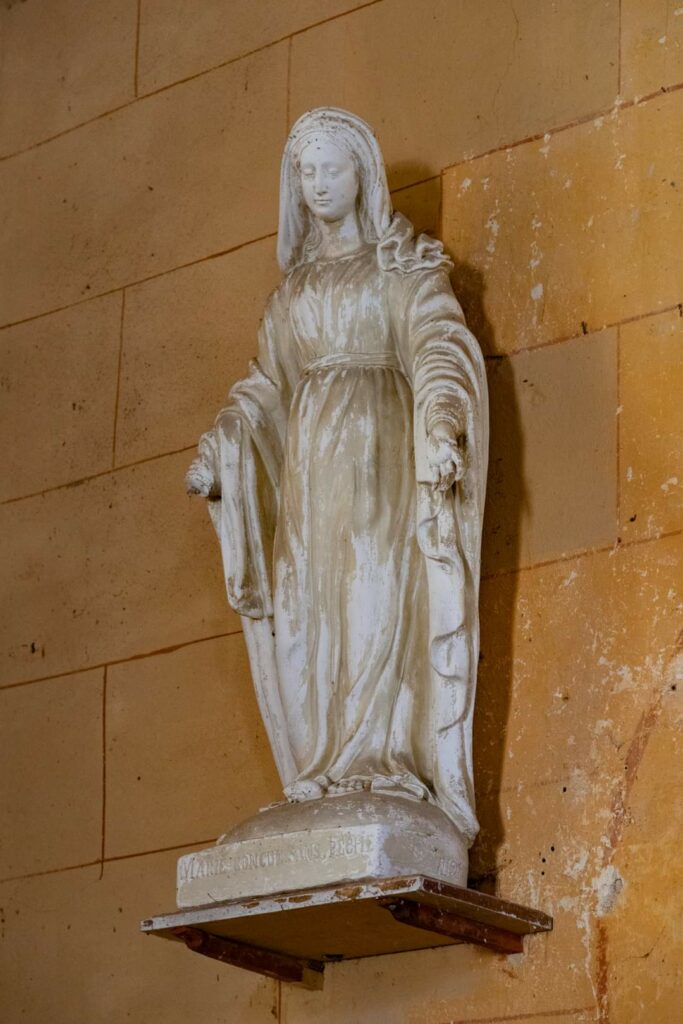
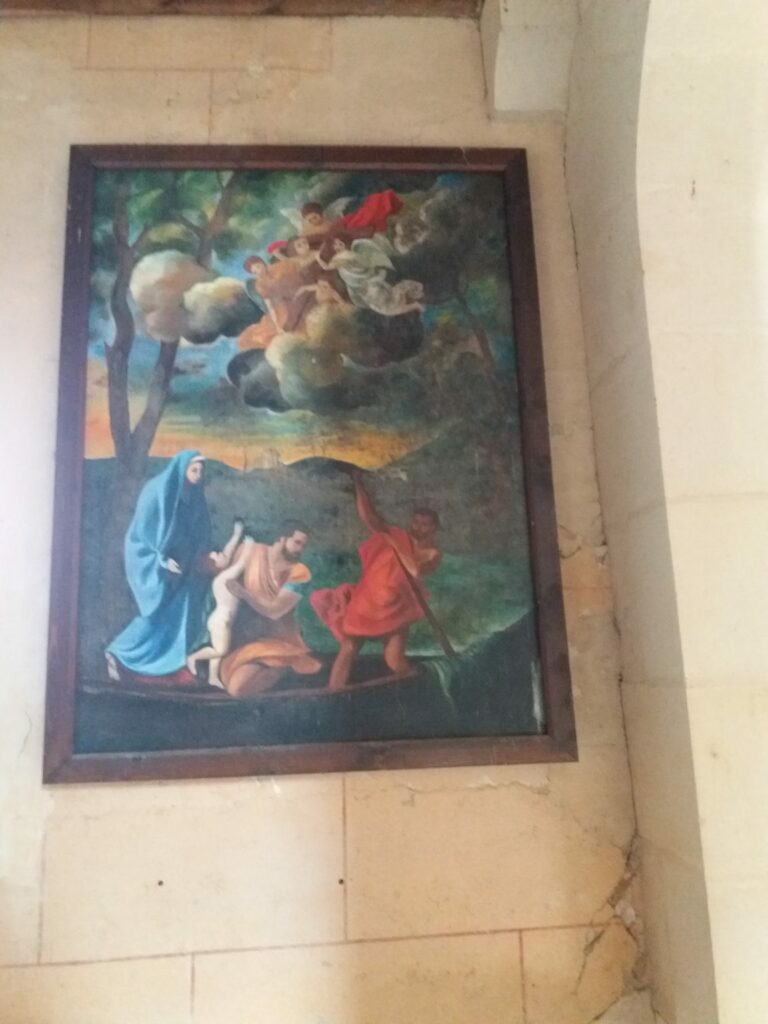

On the left wall by the font.
You can see a painting entitled “Return drom Egypt”. This copy, oil on wood, was inspired by the original by the Italian painter Nicolas Poussin (17th and 18th centuries) and was a gift from Madame Sayet, a former student of the schools of Fine Arts in Beaune, Dijon and Bourges.
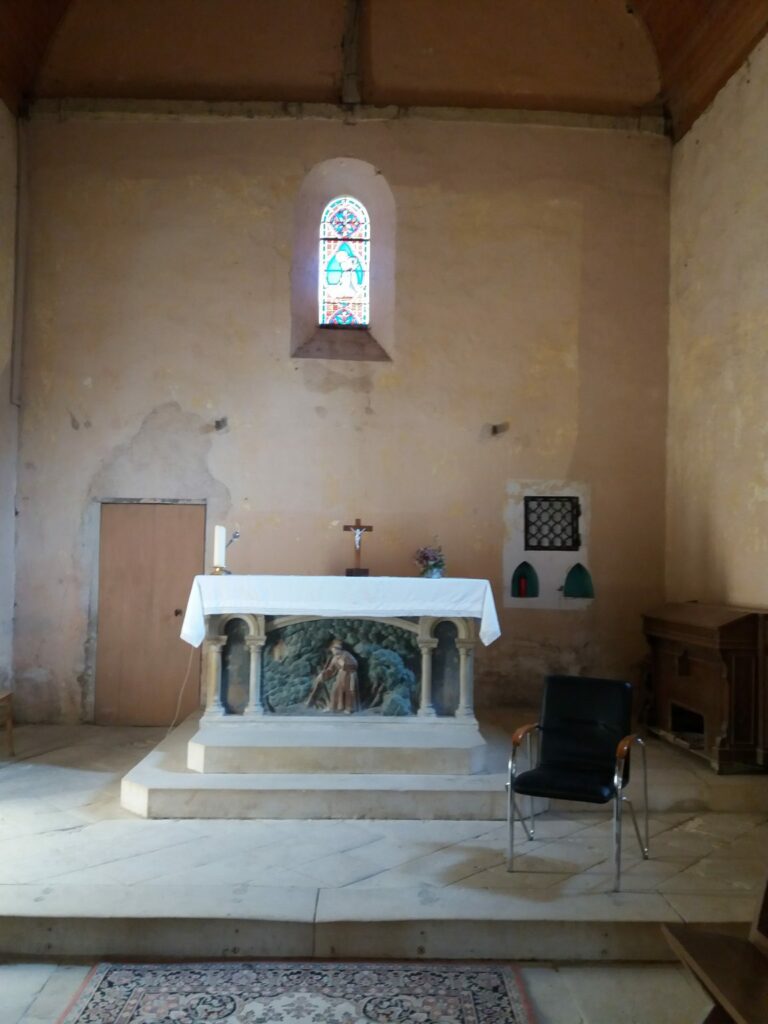
The choir and the nave are separated by a wall with three pointed arches, the central one being higher and wider than the other two.
The front of the altar is the work of JB Villatte and dates back to 1862. The painted stone bas-relief shows a monk holding a stick. In the background of this forest scene a religious building can be seen.
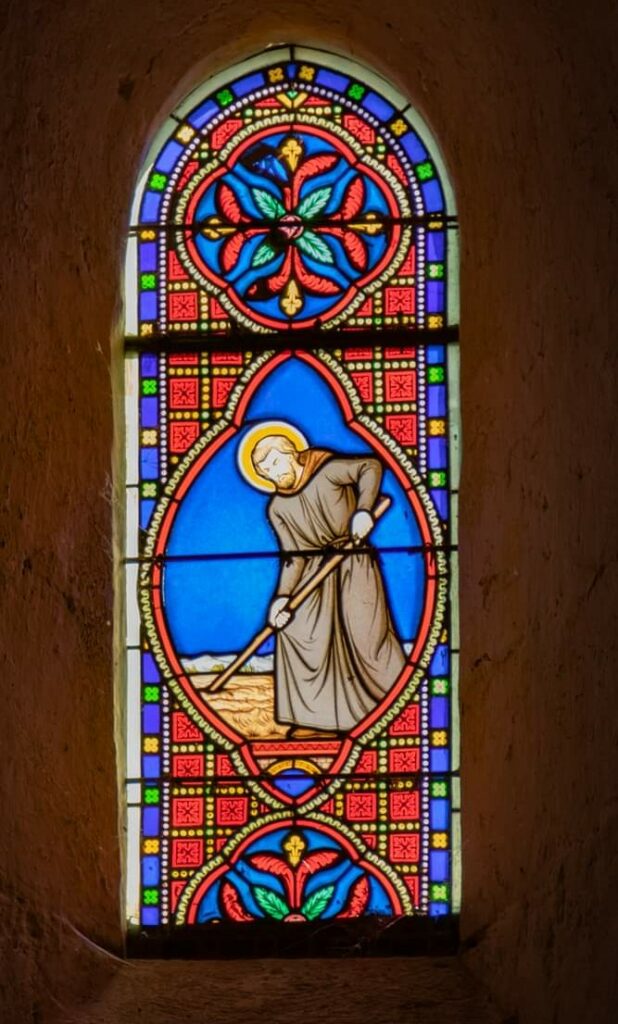
The axis window in the choir is of stained glass and dates back to the 19th century. It shows Saint Fiacre, the patron saint of gardeners.
The stations of the cross, dating from the 1970s/1980s are composed of small square bronze medallions incrusted in wooden crosses.
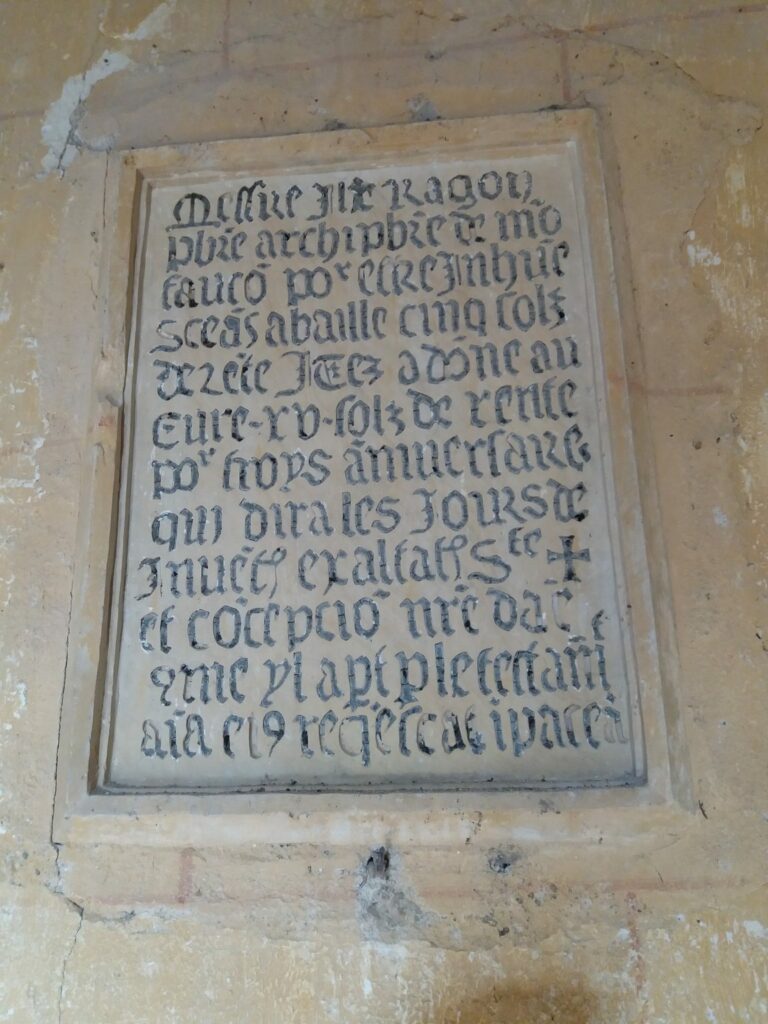
On the north wall is a funeral slab dating back to the end of the 15th century. The slab has been part of the official ‘Historical monuments’ since September 1908.
It concerns Hilaire Ragon, archpriest of Montfaucon (Villequiers).
Mylord Hilaire Ragon
Priest and Archpriest of MontFaucon
To be interred here
Donated five times the property tax,
Moreover he donated fifteen times
The property tax to the curate
For him to say (mass) for 3 years
On the anniversary of
The Exaltation of the cross,
The Conception of Our Lady
As it appears in the testament
Anima ejus requiescat in pace
(May he rest in peace). Amen.
In 2025 the church roof was redone.
Here is a photograph of one of the two bells in the tower.
Exterior
The anomaly of Saligny le Vif
When the map of France was created in 1865, engineers from the Paris Observatory were unable to establish the triangulation of Bourges-Dun-Saligny. This was due to the fact that the belfrey in Dun was hidden by trees, thus making the geodesic signal (highest point) impossible. Another line of sight had to be defined using the church tower. In November of the same year a team of scientists proceeded to calculcate the meridian and the azimuth, and a new geodesic signal was placed on the outside wall of the church. Thus, Saligny le Vif has two geodesic signals.
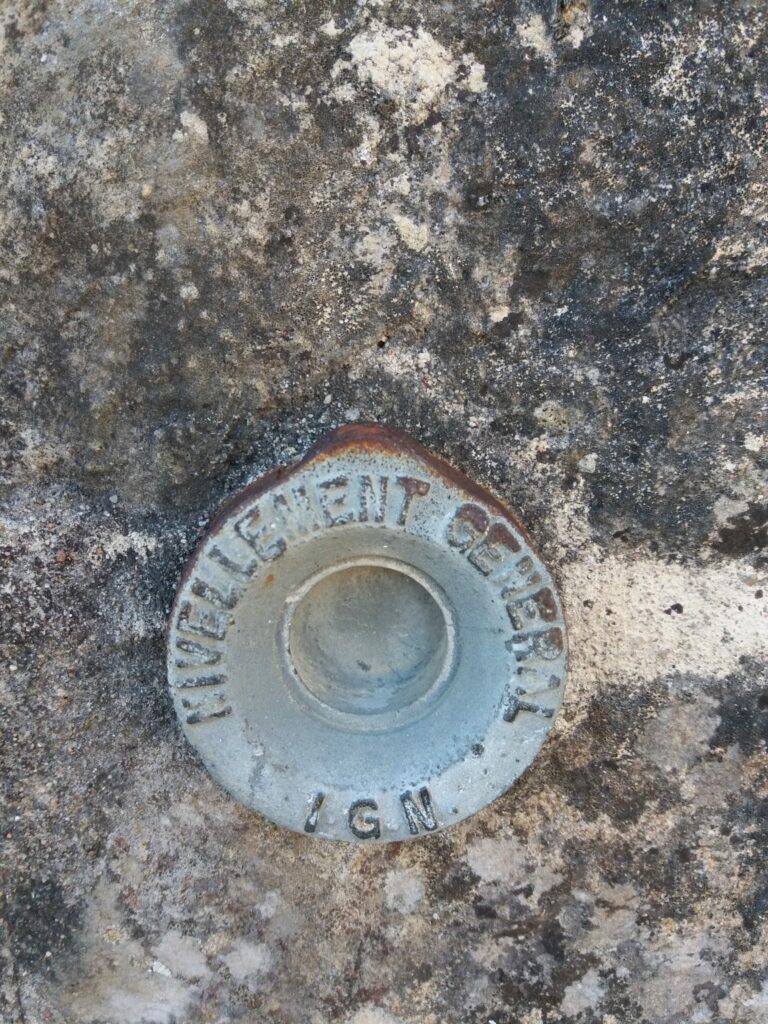
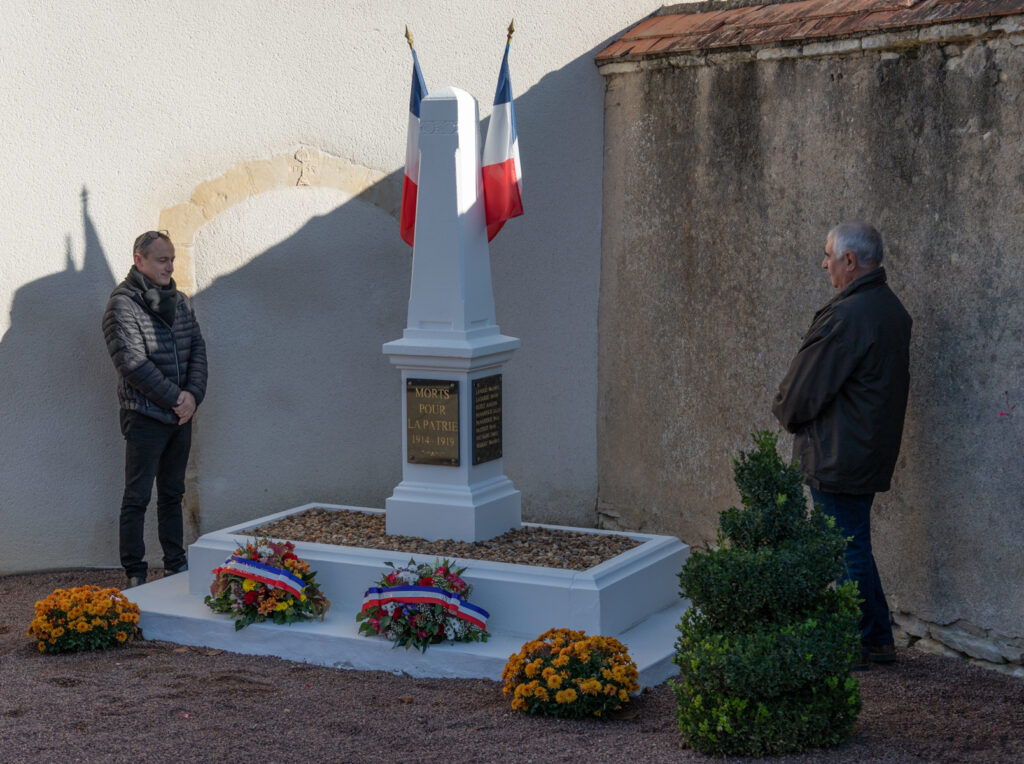
Two doors have been walled up: one in the south wall near the sundial behind the war memorial (1914-1919), and the other in the north wall in the choir, which probably led out to the cemetery.
The cemetery was beside the church until 1934/1935.
The war memorial for the French soldiers who died was inaugurated on December 18th 1919. After speeches by the mayor, Mr Simon, and the president of the local section of the National Union of Combattants, a luncheon was served for the veterans and combattants.
Saint Peter
Peter is one of the apostles.
Simon Bar-Jonah, Andrew’s brother, was the first of Jesus’ disciples to confess the Christ, and Jesus gave him the name of Cephas, which means Peter or rock.
Jesus told him “ You are Peter and on this rock I will build my Church” (Matthew 16:18-19)
Jean-Baptiste Villatte
Native of Le Berry, Jean-Baptiste Villatte was born in Crosses on 15th May 1823.
Villatte excelled in sacred art, some examples of which are found in the seminary of Saint Celestin in Bourges. Several of his statues can be seen in the Capucin cemetery also in Bourges: an angel in prayer above the Corbin family’s chapel, and a monumental carving on a grave in the old part of the cemetery.
Again in Bourges stands Villatte’s fountain, 6 meters high, representing a woman wearing a crown of towers, a symbol of the city, and in her hand a tablet bearing the inscription “ Work- Progress”.
A bronze bust dating back to 1886: portrait of Mr Celesti Girard can be seen in Vierzon.
Villatte sculpted several elements of the church door in Baugy.
Two of his sons, Torello (the eldest) and Louis, also became sculptors.
Saint Fiacre
Saint Fiacre was a monk and herbalist of noble Irish descent. Born around 590, he died between 620 and 630. He founded an episcopal monastery near Meaux, and he is buried there. Legend has it that a woman called Becnaude accused him of sorcery to the diocese. Saint Faron, now aware of the situation, established the veracity of these healings, and and concluded that Fiacre was a saint. Fiacre’s virtue having thus been recognized, he was able to pursue his life of prayer and charity under the protection of Our Lady, to whom he dedicated his monastery. The monastery became a well-known place of pilgrimage. After Fiacre’s death, the monastery was named after him. However, having been affected by the incident, it is said that he forbade women to enter, and this still the case today.
Greatly appreciated during his lifetime, he is the patron saint of gardeners, market gardeners, coachmen and taxi-drivers. His attributes are the spade and the shovel.
Saint Fiacre’s day is on August 30th.